Test Summary
The TCM underwent several tests regarding it’s form factor and how accurately it could measure the specified test materials. All told, the TCM bears the hallmarks of a device not quite capable of reaching its measurement goals. While measuring the test materials, each trial result was in approximate range of one another, but deviated from reference values by around -20-30 W/mK. The system has the form-factor and adaptability to meet the needs of the classroom lab environment it was intended for, and will be able to meet the precision needs following a redesign of its probe.
Device testing will commence in spring quarter. The materials to be tested are:
- Water or 1% gelatin + 99% water at room temperature
- Water or 1% gelatin + 99% water at below room temperature and above freezing
- A potato or apple or sausage at room temperature
- A solid listed in Appendix A-24 or A-25 of the Cengel Thermal-Fluids book, at a known temperature
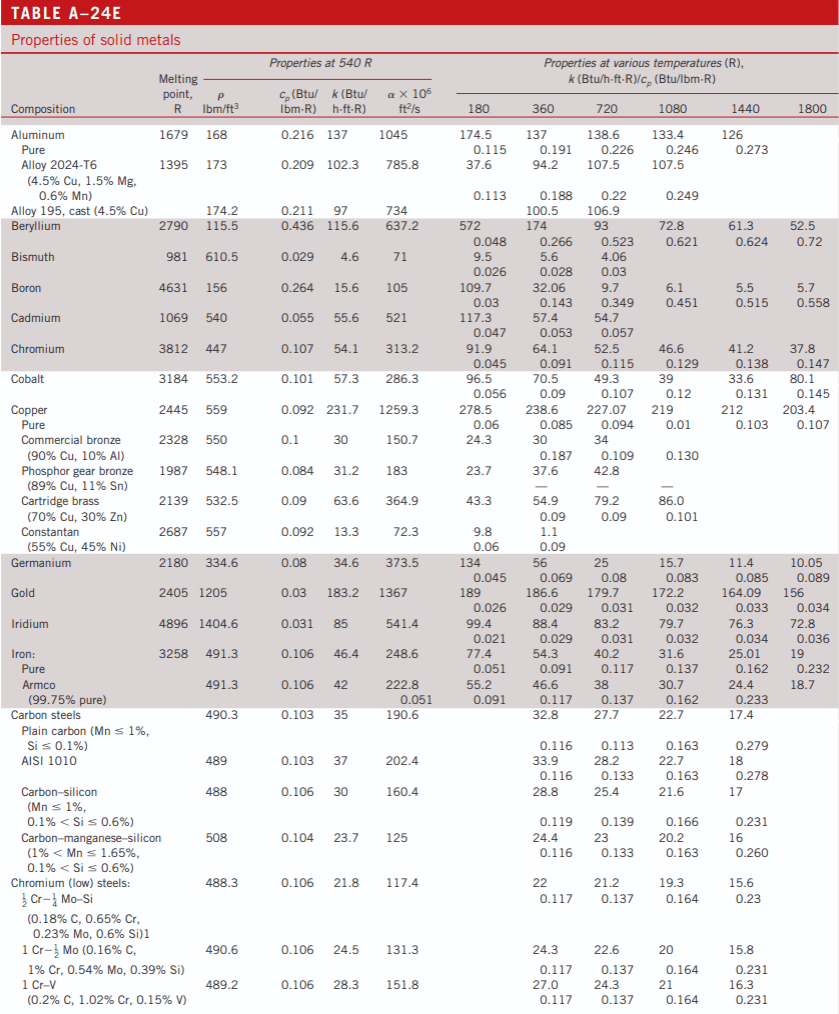
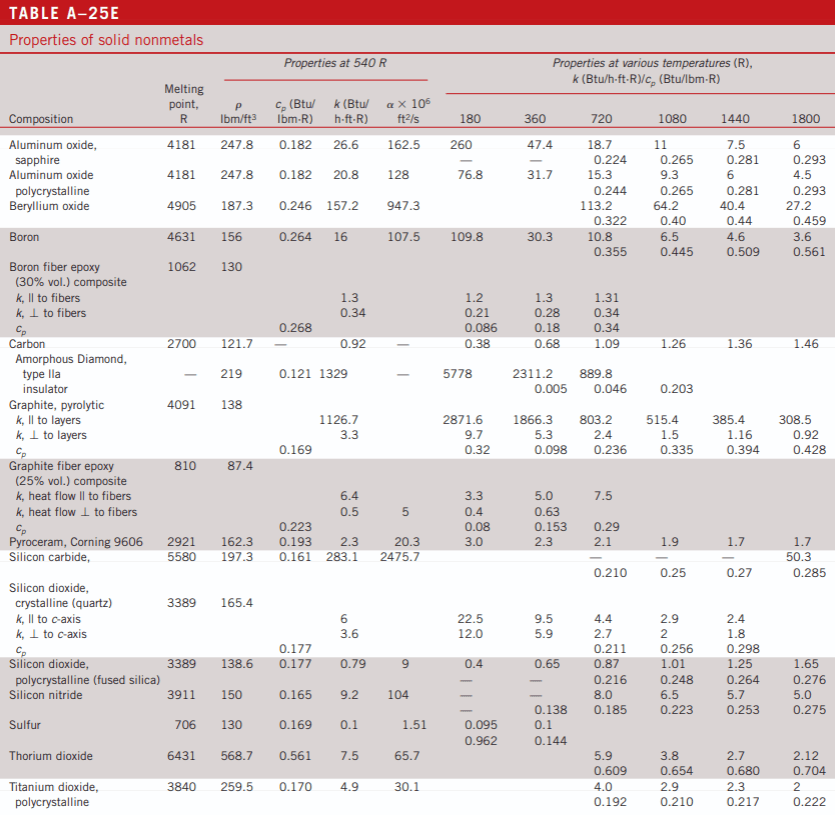
Tables A-24E & A-25E from Fundamentals of Thermal-Fluid Sciences, Fifth Edition
The successful outcome of testing will be several repeat measurements for each material which average out to a thermal conductivity measurement of within 5% of the same values given in Fundamentals of Thermal-Fluid Sciences, Fifth Edition for the materials.
Liquid samples will be tested in an 8 oz jar. TCM’s liquid probe has been designed to mount to a standard wide-mouth jar lid. The jar should be filled to a minimum of 0.5 inches below the lid. If a vessel of a different volume is necessary, a different wide-mouth jar can be used. It was previously thought that an advantage of using a large vessel is a liquid temperature that takes longer to change, which could have been leveraged when measuring ice water for Material #2. Ultimately, a larger vessel was actually found to contribute to more convection losses. An 8 oz jar is the smallest commercially available wide-mouth jar, and was found to help somewhat in limiting losses.
Material #3 choice will be inconsequential and chosen by convenience at the testing time. The most likely solid to be used for Material #4 is one that is also available in the Hogue Room 107 stockroom. Copper, commercial bronze, and plain carbon steel are available and will be chosen depending on testing quantity needed.
Material Testing
Room-Temp Water
Room temperature water was tested, with the expected result to be around 0.55 W/mK. The measurements recorded by the TCM were actually around 0.30 W/mK.
Near-Freezing Water
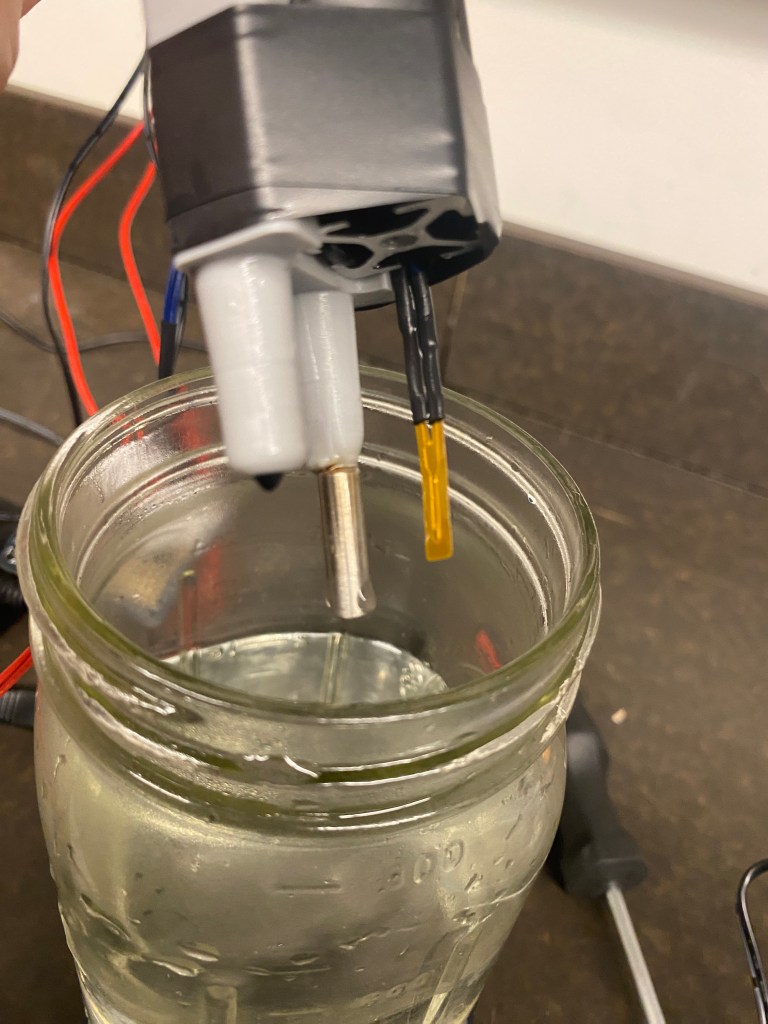
Ice water was tested, with the expected thermal conductivity to measure around 0.50 W/mK. The material chosen was specified in device prerequisites, The actual results were around half of the reference value, near 0.25 W/mK. This is a significant deviation from the expected value, and the measurements themselves suffered from low correlation.
Potato
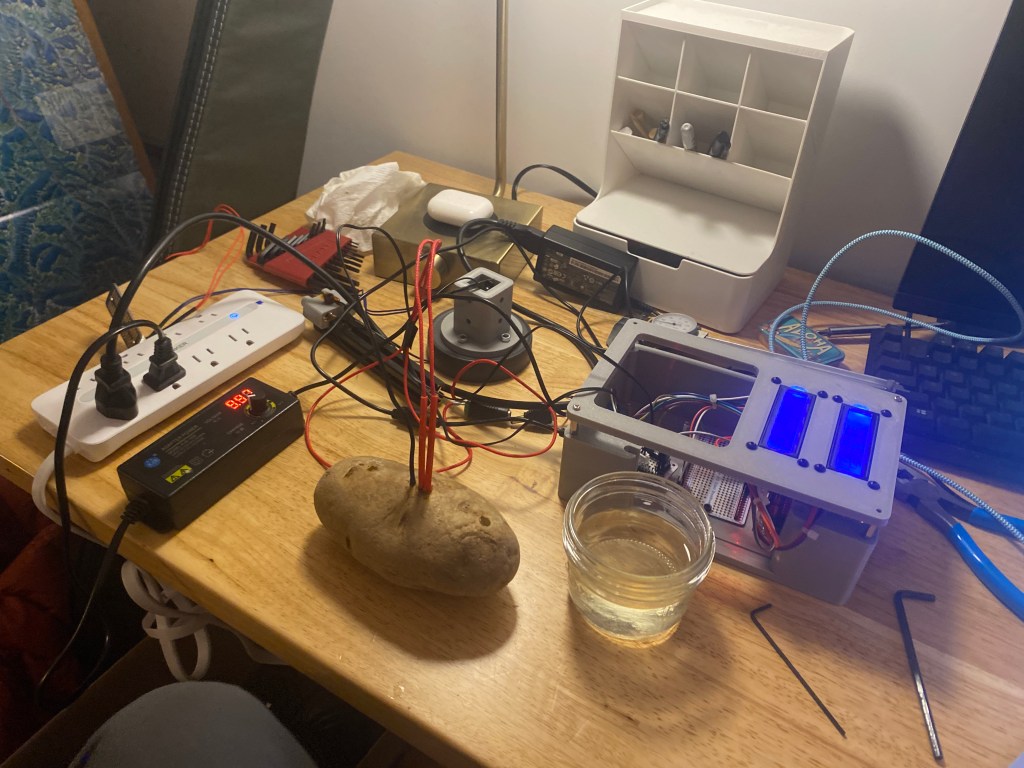
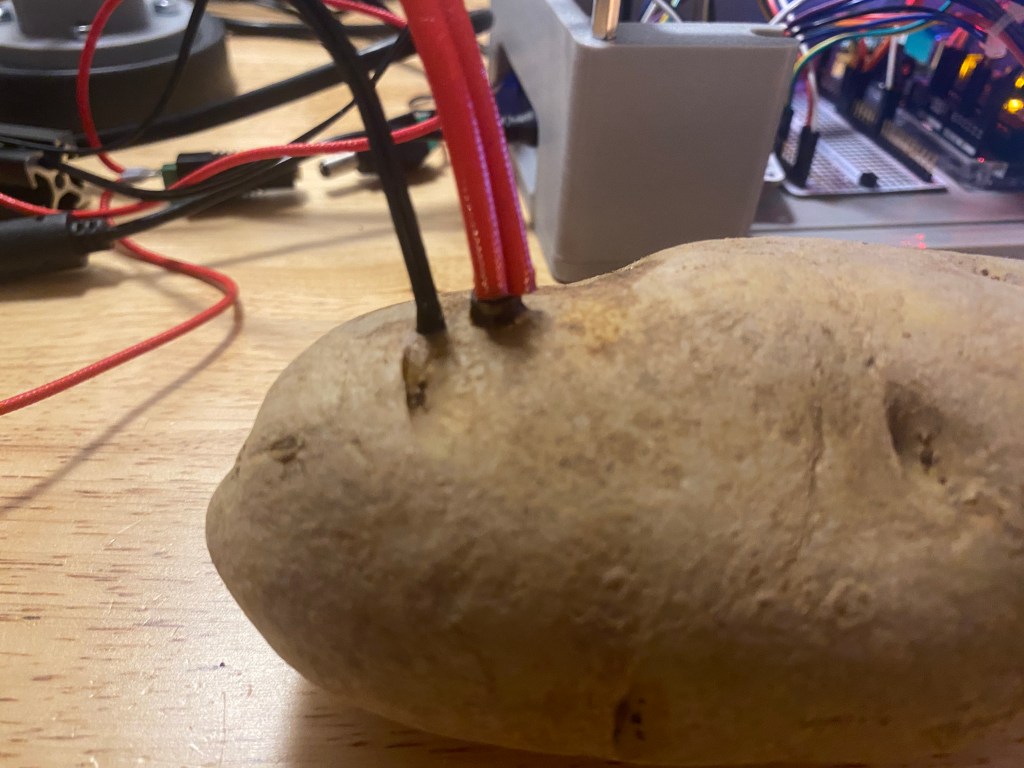
A potato was available as a choice for test material #3. Since a potato consists of mostly water, the expected thermal conductivity reading was around 0.55-0.60 W/mK (the same as for room temperature water). Due to the soft nature of the potato and the need to quickly conduct multiple trials, the thermistor and heater were simply poked into the potato’s flesh. The measurements were lower than expected, averaging around 0.30 W/mK.
Requirement Testing
Weight
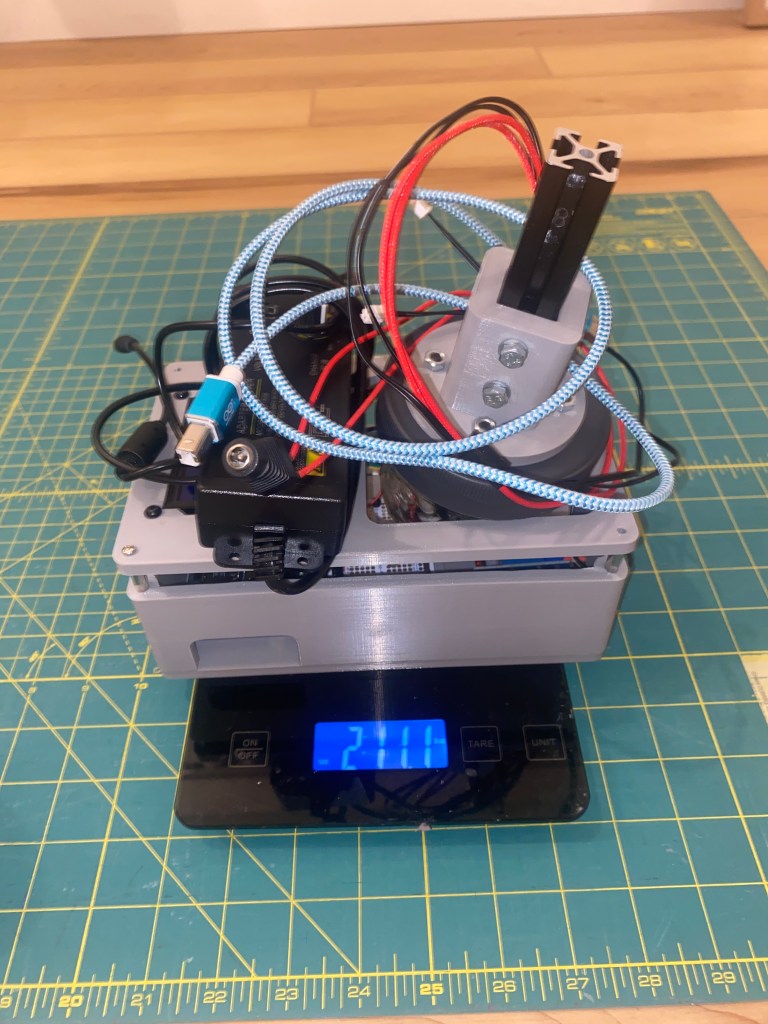
Requirement 1.d.3 specified that the TCM not weigh more than 20 pounds. Prior to construction, it was expected that the system would weigh less than 10 lbs. Ultimately, it was found to weigh 2 lbs 11.1 oz.
Size
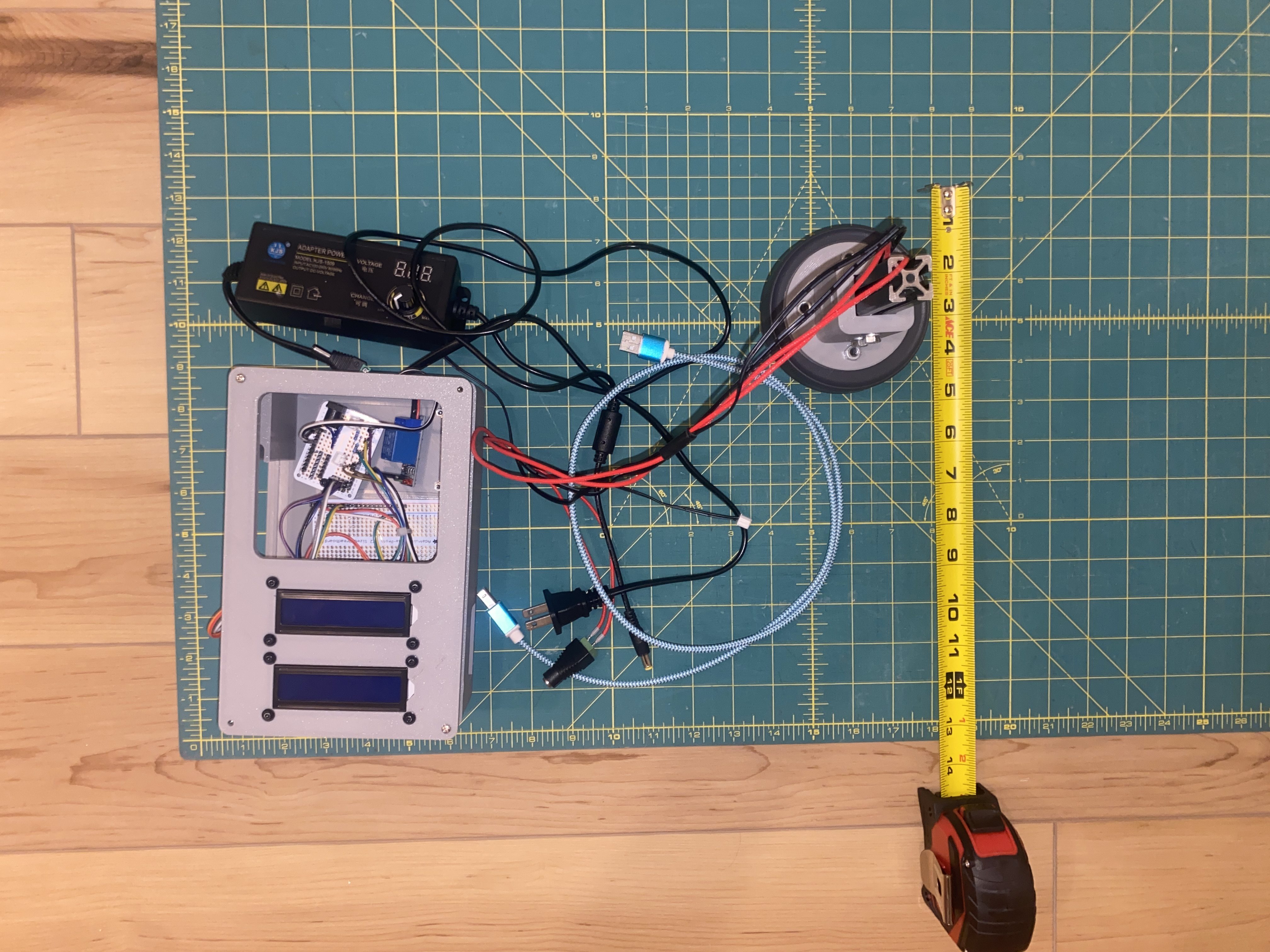
Requirement 1.d.4 specified that the TCM must be no larger than an 18″ L x 13″ W x 10″ H box. This includes all assemblies and cords. It was found that the system fits well within the given dimensions.
LCD Screen Refresh Rate
Requirement 1.d.11 stated that the TCM must have LCD screens capable of a 60 Hz refresh rate. This requirement was determined based on 60 Hz being a common refresh rate for computer monitors. Generic 16×2 LCD screens, like the ones used in the TCM, are not given a refresh rate in their datasheets. Testing using slow-motion footage found the upper screen to refresh around 18 Hz, and the lower one at 12 Hz. Even using slow-motion, each refresh was barely discernable. It was concluded that the Arduino were to display new temperature measurements at a rate anywhere near 8 Hz, they would fly by too quickly for a user to read accurately.
 Thermal Conductivity Meter