Device testing will commence in spring quarter. The materials to be tested are:
- Water or 1% gelatin + 99% water at room temperature
- Water or 1% gelatin + 99% water at below room temperature and above freezing
- A potato or apple or sausage at room temperature
- A solid listed in Appendix A-24 or A-25 of the Cengel Thermal-Fluids book, at a known temperature
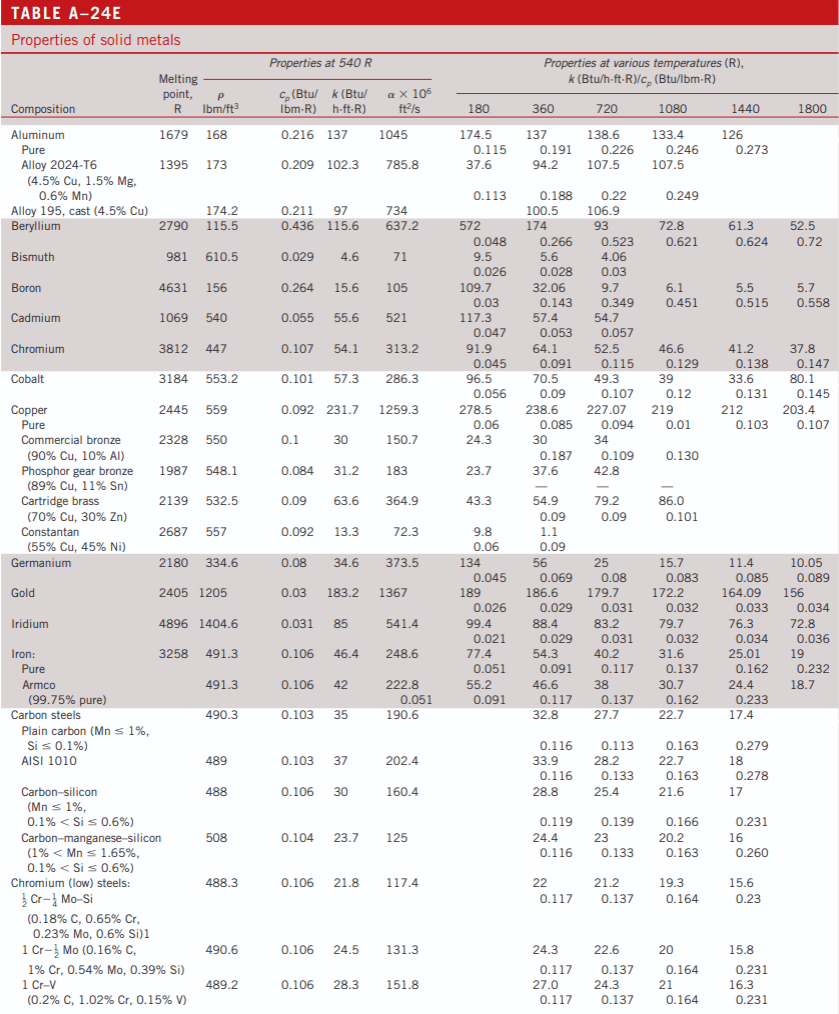
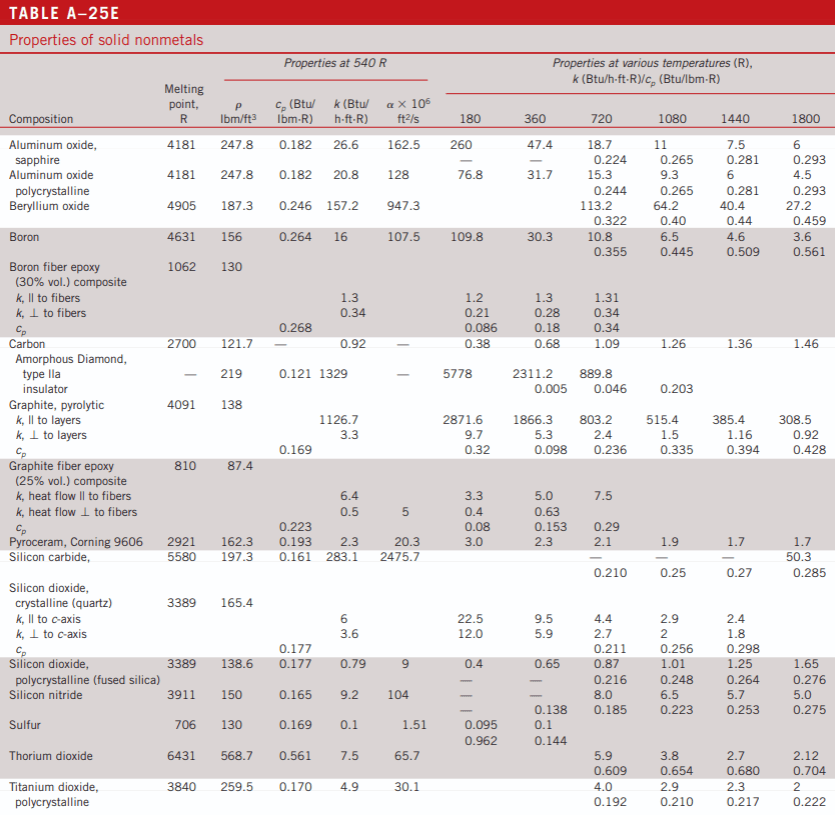
Tables A-24E & A-25E from Fundamentals of Thermal-Fluid Sciences, Fifth Edition
The successful outcome of testing will be several repeat measurements for each material which average out to a thermal conductivity measurement of within 5% of the same values given in Fundamentals of Thermal-Fluid Sciences, Fifth Edition for the materials.
Liquid samples will be tested in a 1 gallon jar. TCM’s liquid probe has been designed to mount to a standard wide-mouth jar lid. The jar should be filled to a minimum of 4 inches below the lid or a max of .5 inches below. If a vessel of lower volume is necessary, a smaller wide-mouth jar can be used. One advantage of using the largest vessel possible is a liquid temperature that takes longer to change, which will be leveraged when measuring ice water for Material #2.
Material #3 choice will be inconsequential and chosen by convenience at the testing time. The most likely solid to be used for Material #4 is one that is also available in the Hogue Room 107 stockroom. Copper, commercial bronze, and plain carbon steel are available and will be chosen depending on testing quantity needed.
Further testing will involve using a multimeter and oscilloscope to verify the electrical system matches the expected power and resistance found in the analyses.
 Thermal Conductivity Meter